Are fluctuating rates cutting into profits? See how a VMS uses smarter rate card management to reduce costs and improve margins.
Staffing costs are often the largest line item for companies that rely on contingent labor - but they’re also among the hardest to control. From fluctuating market rates to inconsistent markups and managers negotiating side deals with staffing suppliers, contingent workforce spending can spiral out of control without strong oversight. That’s where a Vendor Management System (VMS) comes in.
A modern Vendor Management System gives you centralized control over supplier rates through built-in rate card management, helping you reduce costs, enforce consistency, and make data-driven decisions across your entire contingent workforce program.
How a VMS can help you save money on staffing costs
1. Enforce Standardized Rate Cards with Markup Caps
One of the most powerful cost control features of a VMS is the ability to standardize and enforce rate cards.
With a VMS, you can:
-
Define pay rates, bill rates, and markup caps by job category, geography, or even individual supplier.
-
Once those rates are embedded into the system, vendors can’t submit candidates or timesheets outside those parameters without triggering an exception workflow.
-
This prevents vendors from submitting candidates or timecards outside of contract terms.
This eliminates unauthorized rate creep - where vendors slowly raise prices over time - or inconsistent pricing across departments or regions. Your staffing spend stays predictable and aligned with your negotiated contracts.
2. Gain Full Visibility into Pay Rates vs. Bill Rates
Do you know exactly how much of your bill rate goes to the worker - and how much to the supplier?
With a VMS provides you with full visibility into pay rates vs. bill rates on every single assignment, allowing you to:
-
Easily see the markup applied, compare vendor margins across similar roles.
-
Analyze whether you're overpaying for talent.
-
Analyze markup percentages by vendor and role.
This level of detail empowers procurement and HR leaders to not only negotiate better deals, but also ensure vendors are competing on value - not just convenience.
3. Separate Statutory Costs from Supplier Profit
Many companies confuse statutory costs (like payroll taxes, workers’ comp, and other mandated employer expenses) with vendor profit.
A VMS helps you break down your staffing spend, so you can distinguish between what’s legally required and what’s being added as margin.
This allows you to:
- Ensure vendors aren’t padding statutory costs.
- Benchmark fair market margins.
- Improve cost forecasting.
Ultimately, it lets you negotiate more intelligently and avoid paying inflated rates masked as “standard costs.”
4. Track Cost Savings and Cost Avoidance Reporting
One of the most powerful tools in a VMS is its ability to track and report on savings.
With a VMS you can
- Identify how much you saved by enforcing rate caps and flag overpriced submissions
- Analyze vendor markup variances.
- Obtain clear metrics that demonstrate cost avoidance and efficiency improvements over time.
- Run reports by vendor, job category, department, or location.
These reports give you actionable insights to continually improve your staffing spend and optimize your workforce strategy.
5. Eliminate Invoice Surprises
No more unexpected charges or last-minute billing disputes.
Because rate cards are embedded in the VMS:
- Invoicing becomes a closed-loop process.
- The system only allows approved rates to be billed and reduces the risk of overcharges and invoice disputes.
- If a vendor tries to submit a timecard or invoice outside of the agreed-upon terms, it gets automatically flagged - before it hits your finance team.
This closed-loop invoicing process reduces manual checks, speeds up approvals, and builds trust between you and your suppliers.
Stop Letting Staffing Costs Go Unchecked
When contingent labor costs escalate, it’s usually not due to a single wrong decision - it’s because there’s no system in place to enforce good decisions consistently.
A VMS brings structure and transparency to your staffing program:
-
Centralizes and Enforces rate cards and capping markups.
-
Exposes unnecessary costs.
-
Tracks savings in real-time.
-
Provides actionable spend data.
-
Helps procurement and HR make smarter decisions.
In short, a Vendor Management System helps you gain control over your contingent workforce spend and transforms cost management from reactive to strategic.
Ready to Take Control of Your Staffing Spend?
If you’re still relying on manual processes and spreadsheets, or your current software is not delivering what you need, it may be time to explore a modern solution like Conexis VMS - built to help you manage today’s workforce while preparing for tomorrow’s needs.
Learn more about the Benefits of a VMS
Download a copy of our free VMS Buyers Guide - it includes everything to know about a VMS and a checklist of all the questions you should ask a VMS provider; including the Top 10 Pricing questions.
Additional Reading
How a VMS Reduces Contingent Workforce Cost | Guide
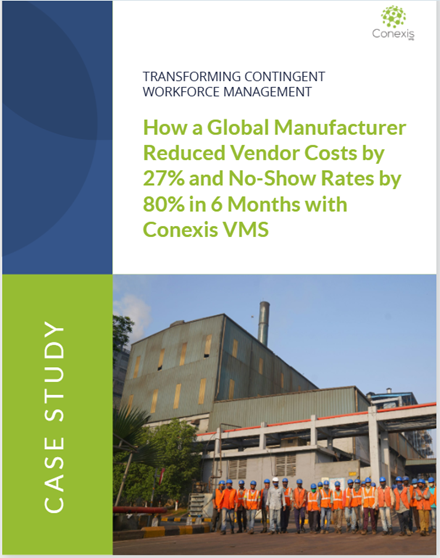
Read Our Conexis VMS Case Study
Case Study: How a Manufacturer Cut Costs by 27% and No Shows by 80% with Conexis VMS
The Conexis VMS Difference
Conexis VMS is an award-winning vendor management system built for organizations that want the power of enterprise software without the complexity or cost.
Leveraging the latest technology, Conexis VMS delivers the expertise, reliability and security of enterprise systems, while offering the flexibility, user friendliness and tailored, personal service you require. Learn more about our Company and what makes Conexis VMS different.
Discover the Power of Conexis VMS
Conexis VMS is trusted by staffing agencies, MSPs and leading organizations to modernize and manage their contingent workforce programs. Here's why organizations choose Conexis VMS:
-
Modern VMS Technology - Built on the latest AWS microservices architecture and Open API
-
Fast Implementation - Get up and running in under a month, free setup and training included
-
Fully Branded White-Label VMS - Your Logo. Your Domain. Your Branded Communication
-
Flexible Pricing - No setup fees, with free implementation, training and account management
- Personal Attention - Experienced senior account management from implementation onward
Switching Your VMS or Just Getting Started?
We work with teams at every stage, from first-time buyers to companies replacing outdated platforms that can't keep up. Either way, we'll show you what a modern VMS looks like, up and running in under 30 days.
 |
 |
 |



 Read More