As your contingent workforce grows, so does the risk of spending that no one approved, no one budgeted for, and no one can see. It is called rogue spend - and for organizations managing a growing non-employee workforce, it is one of the most damaging and least visible threats to operational efficiency.
Research from Ardent Partners estimates that nearly 60% of all contingent labor is unaccounted for in the average company's financial planning. Other studies suggest that up to 55% of contingent spending at some organizations falls entirely outside authorized programs. The cost is not just financial - it is strategic.
This guide explains what rogue spend is, why it happens, how to spot it, and what organizations are doing to eliminate it for good.
What is Rogue Spend in a Contingent Workforce Program?
Rogue spend - also called maverick spend - is spending that occurs when managers source, engage, or hire contingent workers outside of an organization's established procurement processes, rate agreements, or approved vendor channels.
In practical terms, it looks like this:
- A department manager hires a contractor through a staffing agency that is not on your approved vendor list
- A team lead sets their own pay rate for a temporary worker without referencing your rate card
- A business unit pays a freelancer via company credit card or accounts payable with no formal agreement in place
Each of these scenarios represents spend that is financially unaccounted for, compliance-exposed, and invisible to your procurement team - until something goes wrong.
When either of these things happens, rogue spend will start to invisibly affect your business.
Rogue spend is essentially spending that occurs on sourcing, engaging, and hiring contingent workers in scenarios that are not accounted for, not approved, and have not followed a strategic approach to contingent workforce management.
How Does Rogue Spend Happen?
Rogue Spend occurs when your organization lacks a centralized strategy for managing the hiring of non-employee workers. Inadequate contingent workforce management programs lead managers across various departments to work with staffing suppliers outside of established rate agreements, hire temporary non-employee workers using their own methods at self-determined rates, and engage workers outside of authorized purchasing channels.
Why Rogue Spend Happens in Mid-Market Organizations
Rogue spend is not usually the result of bad actors. In most cases, it is a structural problem - not a people problem.
Here is what typically drives it in mid-market companies:
No centralized procurement process for contingent labor.
When there is no single system of record for hiring non-employee workers, department managers default to whatever method gets them staffed fastest. That usually means going outside established channels.
Siloed departments with independent hiring authority.
HR, operations, IT, and finance may all be engaging contractors simultaneously, each using different vendors, different rates, and different onboarding processes - with no shared visibility across the organization.
Over-reliance on manual tools.
Spreadsheets, shared drives, and email chains cannot scale with a growing contingent workforce. They create data gaps, version control issues, and zero real-time visibility into who is spending what.
Rate card non-compliance.
Without a system to enforce negotiated rates, managers often set their own - particularly when filling urgent roles under time pressure. Over time, this rate drift compounds into significant overspend.
Vendor fragmentation.
As companies grow, the number of staffing vendors tends to multiply without strategic oversight. When managers have dozens of vendor options with no performance data or pricing transparency, rogue supplier selection becomes the norm.
The Real Cost of Rogue Spend
Rogue spend is not just a budget line item problem. The downstream effects touch compliance, data integrity, and your ability to make strategic workforce decisions.
Financial overspend.
Without rate card enforcement and vendor consolidation, you lose volume discounts and pay non-standardized rates for the same roles across different departments.
Compliance exposure.
Workers hired outside approved channels may not go through required background checks, credential verification, or proper worker classification review. Misclassification alone can result in significant penalties and legal liability.
Loss of visibility.
When spend is fragmented across departments, leadership does not have visibility and cannot accurately report on total workforce costs, vendor performance, or contractor headcount - making strategic planning nearly impossible.
Supplier fragmentation.
Every vendor that enters your program without going through an approved process weakens your negotiating leverage and creates additional administrative overhead for your back-office team.
Audit risk.
Untracked spend, missing contracts, and inconsistent onboarding documentation create serious exposure during financial or compliance audits.
How to Identify Rogue Spend in Your Organization
Before you can fix the problem, you need to know where to look. Here are the warning signs that rogue spend is already active in your contingent workforce program:
- Invoices from staffing vendors you do not recognize
- Contractors onboarded without going through HR or procurement
- Bill rates that vary widely for the same job title across departments
- No single source of data for active contingent workers and their costs
- Managers who cannot tell you which staffing agency placed a current contractor
- Accounts payable processing payments to vendors not on your approved list
If any of these sound familiar, your organization is likely experiencing rogue spend - even if the scale is not yet visible.
5 Ways to Reduce Rogue Spend in Your Contingent Workforce Program
Rogue spend in the contingent workforce arises when managers act independently, but this isn't necessarily their fault. The absence of centralized management creates this risk, hindering organization-wide visibility into your non-employee workforce and leading to inefficient processes. To effectively address rogue spend, your organization should transition from outdated manual spreadsheets to automated technologies.
1. Centralize Your Contingent Workforce Management
The single most effective thing a mid-market organization can do to reduce rogue spend is to consolidate all contingent workforce activity into one system. When every requisition, vendor, contractor, rate, and invoice flows through a central platform, rogue activity becomes visible - and preventable.
2. Standardize Your Rate Cards and Enforce Them
Establish negotiated rate agreements with your approved vendors and build them into your workflow so that managers cannot bypass them. When rates are locked at the system level, rate drift stops.
3. Consolidate Your Vendor List
Reduce the number of staffing vendors in your program to a manageable, performance-tracked list. Approved vendors should be accessible through a single portal, with performance data visible to procurement. This eliminates the temptation - and the opportunity - for managers to go off-list.
4. Automate Approvals and Requisitions
Replace email-based hiring requests with structured digital requisitions that route through an approval workflow. This creates accountability at every step and ensures that no contractor engagement begins without proper authorization.
5. Implement a Vendor Management System (VMS)
A VMS brings all of the above together in one platform. It centralizes your vendors, enforces rate cards, automates requisitions and onboarding, tracks spend in real time, and gives your entire leadership team clear visibility into contingent workforce costs.
How a VMS Eliminates Rogue Spend
A vendor management system (VMS) is cloud-based software that acts as the single source of truth for your entire contingent workforce program. Instead of spend scattered across departments, spreadsheets, and inboxes, everything lives in one place.
Here is what a VMS does to address rogue spend directly:
Consolidates all vendors in one approved portal, so managers can only select from vendors your organization has vetted and negotiated with.
Enforces rate card compliance automatically, so no contractor can be engaged at an off-contract rate.
Automates requisitions and approvals, creating a documented, auditable trail for every hire.
Provides real-time spend visibility across all departments, so procurement leadership always knows what is being spent, by whom, and with which vendors.
Centralizes contractor data including contracts, credentials, onboarding documents, and invoices - eliminating the documentation gaps that create compliance risk.
Tracks vendor performance, so your organization can make strategic decisions about which staffing partners are delivering value and which are not.
For organizations that have outgrown spreadsheets but have not yet invested in enterprise-level workforce infrastructure, a modern VMS offers enterprise capability without enterprise complexity or cost.
How does a VMS Help?
VMS software is a cloud-based technology that allows you to consolidate your vendors and manage every step of your contingent workforce in one central database. Using a VMS will allow your organization to structure and optimize every process in relation to hiring non-employee workers and measuring vendor performance.
A vendor management system will automate transactions, store non-employee workforce data, facilitate onboarding, measure vendor performance, collect requisitions from managers and consolidate all of your vendors in one location.
By centralizing your entire non-employee process in one place, every stakeholder in your business will be aligned with your contingent workforce strategy and your business will have clear visibility into contingent workforce spend.
Who Benefits Most from Addressing Rogue Spend?
Rogue spend reduction tends to deliver the most immediate impact for:
Organizations with multiple departments hiring contractors independently. The more decentralized your hiring, the more rogue spend is likely already occurring - often invisibly.
Organizations using five or more staffing vendors. Vendor proliferation is one of the primary drivers of rogue spend. Consolidating through a VMS creates immediate pricing leverage and visibility.
Procurement managers under pressure to reduce costs. If you are being asked to do more with less, eliminating rogue spend is one of the fastest ways to recover budget without cutting headcount or programs.
Companies preparing for growth or expansion. The structural gaps that allow rogue spend to thrive at current scale will only compound as you add more departments, more vendors, and more contractors.
Final Thoughts
Rogue spend in a contingent workforce program is not a sign that your managers are making bad decisions. It is a sign that your organization has outgrown its current processes and tools. The good news is that it is entirely solvable - and the organizations that address it early gain a significant cost and compliance advantage as their contingent workforce scales.
A modern VMS gives companies the visibility, control, and vendor governance they need to eliminate rogue spend and manage their contingent workforce strategically.
Frequently Asked Questions
What is the difference between rogue spend and maverick spend?
The terms are used interchangeably. Both refer to contingent workforce spending that occurs outside of approved procurement channels, negotiated rate agreements, or established vendor programs.
How much rogue spend is typical in a contingent workforce program?
Research varies, but estimates range from 23% to 60% of contingent labor spend being unaccounted for or off-contract in the average organization. The figure tends to be higher in companies without a centralized VMS or structured contingent workforce program.
Can a small or mid-market company afford a VMS?
Yes. Modern VMS platforms like Conexis VMS are built specifically for mid-market organizations and offer flexible, transparent pricing - including free setup - without the complexity or cost of enterprise systems.
How quickly can a VMS reduce rogue spend?
Results vary by organization, but companies that centralize their contingent workforce management through a VMS typically gain full spend visibility within the first few weeks of deployment. Conexis VMS can be deployed in as little as 21 days.
What is spend under management?
Spend under management refers to the percentage of your total contingent workforce spend that flows through your approved program and is tracked, managed, and optimized. Increasing spend under management is the direct outcome of reducing rogue spend.
Learn more about the Benefits of a VMS
Download a copy of our free VMS Buyers Guide - it includes everything to know about a VMS and a checklist of all the questions you should ask a VMS provider; including the Top 10 Pricing questions.
Related Reading
Everything You Need to Know about VMS Cost Savings | Guide
- Driving Spend Under Management in a Contingent Workforce Program
- How to Save 20% on Your Contingent Workforce Cost with a VMS
- Why Spreadsheets May Be Costing You Millions in Contingent Labor Spend
- How a VMS Lowers Contingent Workforce Costs
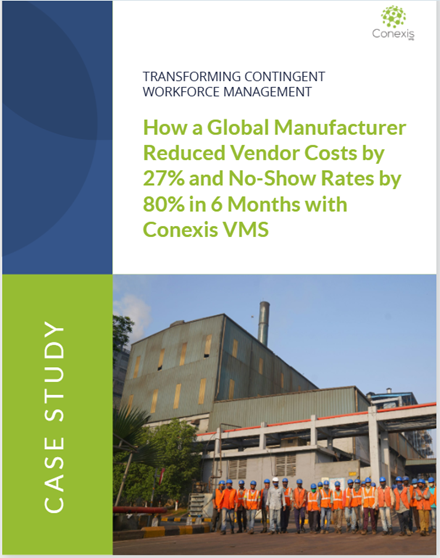
Conexis VMS Case Study
Case Study: How a Manufacturer Cut Costs by 27% and No Shows by 80% with Conexis VMS
The Conexis VMS Difference
Conexis VMS is an award-winning vendor management system built for organizations that want the power of enterprise software without the complexity or cost.
Leveraging the latest technology, Conexis VMS delivers the expertise, reliability and security of enterprise systems, while offering the flexibility, user friendliness and tailored, personal service you require. Learn more about our Company and what makes Conexis VMS different.
Discover the Power of Conexis VMS
Conexis VMS is trusted by staffing agencies, MSPs and leading organizations to modernize and manage their contingent workforce programs. Here's why organizations choose Conexis VMS:
-
Modern VMS Technology - Built on the latest AWS microservices architecture and Open API
-
Fast Implementation - Get up and running in under a month, free setup and training included
-
Fully Branded White-Label VMS - Your Logo. Your Domain. Your Branded Communication
-
Flexible Pricing - No setup fees, with free implementation, training and account management
- Personal Attention - Experienced senior account management from implementation onward
Switching Your VMS or Just Getting Started?
We work with teams at every stage, from first-time buyers to companies replacing outdated platforms that can't keep up. Either way, we'll show you what a modern VMS looks like, up and running in under 30 days.
 |
 |
 |



 Read More