Managing contingent labor effectively is essential for companies seeking to optimize costs, mitigate risks, and gain control over a significant portion of their workforce. In this article, we delve into the three key stages of driving spend under management (SUM) and how each contributes significantly to optimizing your contingent workforce program.
Driving Spend Under Management
Driving spend under management (SUM) within a contingent workforce program is a strategic process that unfolds in three primary stages: Visibility, Control, and Change. Each stage plays a crucial role in enhancing the program's efficiency and effectiveness, ultimately leading to significant cost savings and improved operational performance.
1. Visibility: The Foundation of Spend Management
The first stage in driving spend under management is achieving complete visibility. This stage involves gathering comprehensive data on all contingent workers, including their roles, rates, and the staffing agencies that supply them. It is impossible to manage spend effectively without a clear understanding of who is working for your organization and under what terms.
Visibility entails centralizing all relevant information into a single platform, typically a Vendor Management System (VMS). This platform should capture data on worker classifications, contract terms, bill rates, tenure, and agency performance. By consolidating this data, organizations can identify patterns, trends, and potential areas of concern.
Achieving visibility is not just about data collection; it's about ensuring the data is accurate, up-to-date, and accessible. This transparency allows for better decision-making and sets the stage for the subsequent phases of spend management. Once visibility is established, organizations can start quantifying their contingent labor spend, tracking compliance with internal policies and external regulations, and identifying opportunities for improvement.
2. Control: Leveraging Data for Strategic Management
With visibility achieved, the next stage is establishing control over the contingent workforce program. Control involves using empirical data to baseline processes, costs, and risks and then developing strategies for optimization based on best-in-market data points.
This stage is where organizations begin to take actionable steps toward managing their spend. By analyzing the data collected during the visibility stage, companies can identify inefficiencies, such as over-reliance on specific agencies, inconsistent pay rates for similar roles, or non-compliance with internal guidelines. This analysis forms the basis for developing a business case for change.
The business case should outline potential benefits, including cost savings, reduced risk, and improved process efficiency. By benchmarking against industry standards and best practices, organizations can identify specific areas for improvement. For example, renegotiating contracts with staffing agencies, standardizing pay rates across similar roles or implementing stricter compliance checks are all strategies that can emerge from this analysis.
Control is about moving from reactive to proactive management. It's about setting up governance structures, defining clear policies, and using data to drive decision-making. The goal is to create a more predictable, transparent, cost-effective contingent workforce program.
3. Change: Implementing and Advocating for Improvement
The final stage is driving change within the organization. With a strong business case and significant internal political support, organizations can advocate for changes in processes, policies, risk mitigation strategies, and cost structures.
Change management is critical in this stage. It's not just about implementing new policies or processes; it's about ensuring these changes are adopted across the organization. This requires clear communication, training, and ongoing support to ensure that stakeholders understand the benefits of the changes and how to implement them effectively.
Advocating for change also involves monitoring the impact of these changes and adjusting as necessary. This could mean refining processes, renegotiating contracts, or investing in new technology to support the program. The objective is to create a continuous improvement cycle where the organization constantly refines and optimizes its contingent workforce program.
The Path to Continuous Improvement
Driving spend under management is not a one-time effort but an ongoing visibility, control, and change process. After implementing initial changes, organizations should revisit the visibility stage to gather new data and assess the impact of their efforts. This iterative process allows for continuous improvement and increases spend under management over time.
To make change happen, it is essential to secure executive sponsorship, build a coalition of support across departments, and communicate the program's benefits clearly and consistently. By following these steps, organizations can create a more efficient, cost-effective, and compliant contingent workforce program that delivers long-term value.
Driving spend under management is a strategic endeavor that requires commitment, data-driven decision-making, and a willingness to embrace change. By following the stages of visibility, control, and change, organizations can achieve greater transparency, optimize costs, and ensure that their contingent workforce program is aligned with their overall business objectives.
Learn more about the Benefits of a VMS
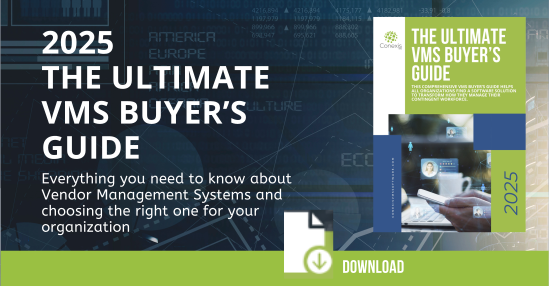
Download a copy of our free VMS Buyers Guide - it includes everything to know about a VMS and a checklist of all the questions you should ask a VMS provider; including the Top 10 Pricing questions.
Additional Articles on the Cost and ROI of a VMS
Everything You Need to Know about VMS Cost Savings | Guide
Funding Your VMS:
Cost and ROI of a VMS
- How Much Does a VMS Cost?
- A Quick Overview of Vendor Management System Pricing
- Maximize ROI: Top 4 Vendor Management System Best Practices
- VMS ROI: What Size of Operation Do You Need to Make a VMS Worthwhile?
- Vendor Management Software: What's the Cost & ROI?
- What Size of Operation Do You Need to Make a VMS Worthwhile?
- 5 Best Practices to Optimize your Vendors and Maximize ROI
- Save money with Conexis VMS flexible pricing
- 10 Questions to ask a VMS Provider about Cost and Pricing
Cost Per Hire
Staffing Agencies
- 5 Ways a VMS Reduces Staffing Costs with Smart Rate Card Management
- Staffing Agency Bill Rate: What is it?
- Staffing Agencies: How a VMS can increase your Revenue
MSPs
Government
Contingent Workforce Spend & Cost Reduction
- How to Save 20% on your Contingent Workforce Cost with a VMS
- How a VMS Lowers Contingent Workforce Costs
- How to Manage Contingent Workforce Rogue Spend
- Driving Spend Under Management in a Contingent Workforce Program
- 4 Ways to use your VMS to Control Contingent Workforce Cost and Save Money
- 4 Ways to Gain Control of Your Contingent Workforce Spend
- How a VMS helps you Control Costs during Market Uncertainty
- Why Spreadsheets may be costing you millions in Contingent Labor Spend
- Do you know what you're spending on Contingent Workers this year?
Conexis VMS Case Study
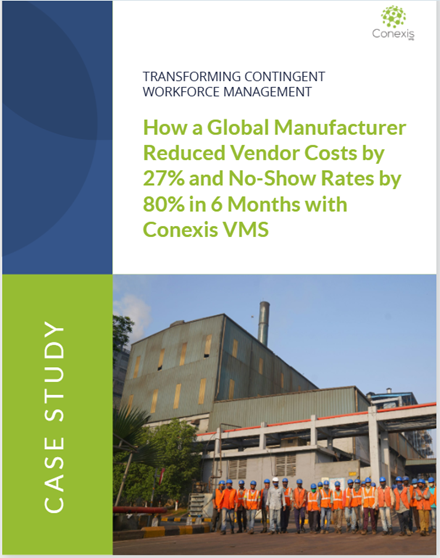
Case Study: How a Manufacturer Cut Costs by 27% and No Shows by 80% with Conexis VMS
The Conexis VMS Difference
Conexis VMS is an award-winning vendor management system built for organizations that want the power of enterprise software without the complexity or cost.
Leveraging the latest technology, Conexis VMS delivers the expertise, reliability and security of enterprise systems, while offering the flexibility, user friendliness and tailored, personal service you require. Learn more about our Company and what makes Conexis VMS different.
Discover the Power of Conexis VMS
Conexis VMS is trusted by staffing agencies, MSPs and leading organizations to modernize and manage their contingent workforce programs. Here's why organizations choose Conexis VMS:
- Modern VMS Technology - Built on the latest AWS microservices architecture and Open API
- Fast Implementation - Get up and running in under a month, free setup and training included
- Fully Branded White-Label VMS - Your Logo. Your Domain. Your Branded Communication
- Flexible Pricing - No setup fees, with free implementation, training and account management
- Personal Attention - Experienced senior account management from implementation onward
Switching Your VMS or Just Getting Started?
We work with teams at every stage, from first-time buyers to companies replacing outdated platforms that can't keep up. Either way, we'll show you what a modern VMS looks like, up and running in under 30 days.
 |
 |
 |



 Read More