Are contractors really more expensive than full-time employees? We break down the numbers, debunk the myths, and show how the right strategy saves money.
In this article, we will tackle the misconception that contract employees cost more than permanent ones. We will explore why many companies hold this belief, examine the reasons it is incorrect, and discuss how an effective contingent workforce management strategy can help your business meet its hiring goals and reduce expenses.
There is a great debate that occurs constantly in organizations as they look at the cost of using contract workers vs hiring full-time employees. In this article, we will look at this, as well as other, more critical questions that should be also be considered.
What’s More Expensive: A Contractor or a Full-Time Employee?
The True Cost Comparison Might Surprise You
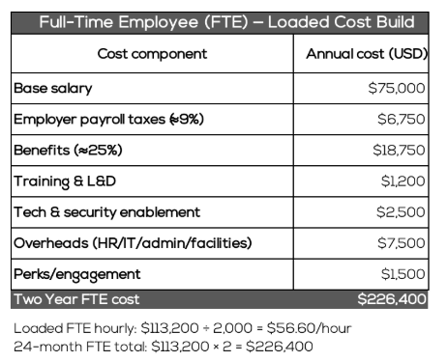
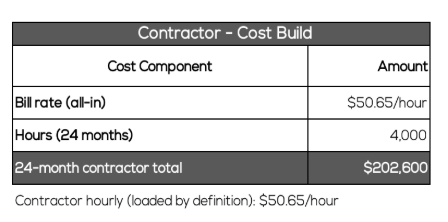
For fun, let’s analyze the cost of staffing a Data Center Manager in Cleveland, Ohio, for a 24-month project. Do you hire a full-time employee at USD 75,000 or use a contractor at an all-in bill rate? Using a 2,000-hour work year (4,000 hours over two years), here’s an apples-to-apples comparison – using Indeed as our primary source of rate and salary data.
Real-World Cost Comparison: Contractor vs. Employee
Example: Comparing the cost of staffing a Data Center Manager in Cleveland, Ohio, for a 24-month project:
-
A full-time employee with a salary of $75,000/year
-
A contractor hired at an all-in bill rate
Using a 2,000-hour work year (4,000 hours over 2 years), here’s how the numbers play out. All estimates are based on average rates from Indeed and typical employer cost assumptions for Ohio.
Assumptions (Cleveland/Ohio) – Actuals may vary
- Payroll taxes: 9% of salary (employer FICA + unemployment blend).
- Benefits: 25% of salary (medical/dental/vision, retirement match, paid time off accrual).
- Training: $1,200/year (technical refreshers, certifications).
- Technology & security enablement: $2,500/year (laptop, licenses, MDM/IAM, security tools).
- Overheads: $7,500/year (HR, finance, IT admin, facilities).
- Perks/engagement: $1,500/year (wellness, events, small stipends).
Final Result: It’s a Wash (Almost)
-
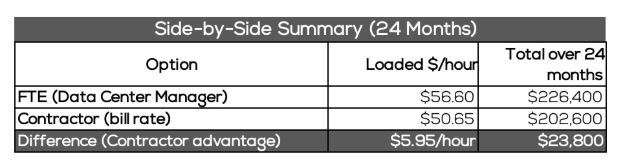
Total 2-Year Cost (FTE): $226,400
-
Total 2-Year Cost (Contractor): $202,600
-
Savings with Contractor: $23,800 over 2 years or $5.95/hour
That might sound like a significant saving, but it’s not the whole story.
What the numbers mean
Pure cost:
At these assumptions, the contractor is $23.8K cheaper over 24 months. You save $5.95 per hour vs. the fully loaded FTE.
Risk & flexibility:
The contractor option minimizes employment risk, speeds onboarding, and makes ramp-down trivial when the project ends - especially useful in project work, unique hot skillsets, and short-term worker backfill.
Control & continuity:
An FTE can deepen institutional knowledge (runbooks, topology familiarity, vendor relationships) and often stretches beyond the job description - value not captured in an hourly model.
Security posture:
With an FTE, you’ll invest more in long-term enablement (Zero Trust tooling, privileged access management hygiene, training cadence). Contractors may already be “tool-ready,” but ensure your access controls, monitoring, and off-boarding are watertight.
Final Thoughts:
I have run these cost models for well over 25 years, and I still get the same cost-neutral result. Therefore, I urge organizations to understand and apply decision-making trees based on when it is more advantageous to their organization to use a contractor over a full-time employee.
Looking to Make a Smarter Workforce Strategy?
At Conexis VMS, we help companies evaluate and manage their contingent workforce through cost-effective, flexible solutions. Give us a call. Let’s talk about how we can help you optimize your talent mix - contractor or full-time. Book a free workforce strategy session
Additional Reading
- Cost Savings: How you can save 20% on your contingent workforce costs
- Reducing Risk: Everything you need to know about Contingent Workforce Risk
- Improving Compliance: 10 Ways a VMS helps improve contingent workforce compliance
- Managing Shift-Workers: 5 Ways a VMS helps you manage shift-based workers
- Improving Invoicing: 5 Ways a VMS streamlines and improves invoicing
- Increasing Visibility: How a VMS gives you visibility into your CW program
- Measuring Staffing Agency: How a VMS improves staffing agency performance
- Reducing Turnover: How to Reduce Turnover in Your Contingent Workforce Program
- KPIs: 4 KPIs to Improve Your Contingent Workforce Management Program
Learn about the Benefits of a Vendor Management System
Learn more about the Benefits of a Vendor Management System and how to choose the right one for your organization. Download our Free VMS Buyer's Guide here:
Read Our Conexis VMS Case Study
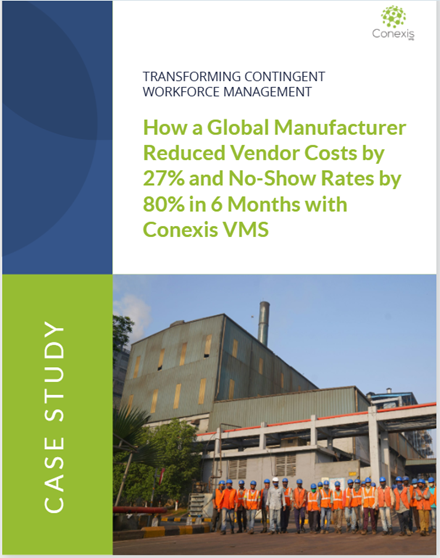
Case Study: How a Manufacturer Cut Costs by 27% and No Shows by 80% with Conexis VMS
The Conexis VMS Difference
Conexis VMS is an award-winning vendor management system built for organizations that want the power of enterprise software without the complexity or cost.
Leveraging the latest technology, Conexis VMS delivers the expertise, reliability and security of enterprise systems, while offering the flexibility, user friendliness and tailored, personal service you require. Learn more about our Company and what makes Conexis VMS different.
Discover the Power of Conexis VMS
Conexis VMS is trusted by staffing agencies, MSPs and leading organizations to modernize and manage their contingent workforce programs. Here's why organizations choose Conexis VMS:
-
Modern VMS Technology - Built on the latest AWS microservices architecture and Open API
-
Fast Implementation - Get up and running in under a month, free setup and training included
-
Fully Branded White-Label VMS - Your Logo. Your Domain. Your Branded Communication
-
Flexible Pricing - No setup fees, with free implementation, training and account management
- Personal Attention - Experienced senior account management from implementation onward
Switching Your VMS or Just Getting Started?
We work with teams at every stage, from first-time buyers to companies replacing outdated platforms that can't keep up. Either way, we'll show you what a modern VMS looks like, up and running in under 30 days.
 |
 |
 |



 Read More