Picking a VMS is only half the decision, figuring out who actually pays for it is the other half. Here's how vendor-funded, client-funded, and hybrid models really compare, so you can choose the one that fits your program.
Budgets are tight, ROI is essential, and hidden costs can derail adoption. Fortunately, there are multiple ways to fund a VMS - and you don’t always have to pay entirely out of pocket. Understanding the benefits, trade-offs, and financial impact of each model is key to making the right choice for your organization.
The three main funding approaches are:
- Vendor-Funded (Supplier-Funded)
- Client-Funded (Subscription-Based)
- Hybrid-Funded (Combination)
Modern VMS platforms, like Conexis VMS, support all three funding models - giving you the flexibility to choose or change your approach as your program evolves.
Vendor-Funded Vendor Management System
What is a Vendor-Funded VMS?
Vendor-funded VMS (also referred to as Supplier-Funded) means the staffing suppliers pay the software fee, typically as a percentage of labor spend billed to the client. Costs are often embedded in supplier bill rates, so the organization may not see a direct software invoice.
How Vendor-Funded Works
- Suppliers pay a percentage of labor spend, typically .5% to 1%
- Fee is included in the supplier bill rates rather than invoiced directly to the client
- Common in MSP-managed programs
Vendor-Funded Benefits
- No upfront software cost
- Faster internal approvals
- Quick adoption for new programs
Vendor-Funded Trade-Offs
- Costs may be indirectly passed back via higher bill rates
- Less transparency into actual program spend
- Supplier margin pressure may occur
- Switching MSPs or suppliers can be more complex
- Organizations struggle to distribute funds back to the business when collecting the funds.
Tip: Vendor-funded doesn’t mean free - it just shifts who pays, not whether someone pays.
Client-Funded Vendor Management System
What is a Client-Funded VMS?
Client-funded VMS is a subscription-based model where your organization pays the software fee directly.
How Client-Funded Works
- Fees are typically billed monthly
- Pricing is usually based on the number of workers or spend volume
- Common in procurement-led or mid-market/enterprise programs
Client-Funded Benefits
- Full cost transparency
- Greater control over the system, suppliers and program rules
- Easier to switch MSPs or vendors without hidden fees
Client-Funded Trade-Offs
- Although not as prevalent, supplier pushback can be an issue
- Costs are visible as software spend
- Larger suppliers feel they have more power over the system
Hybrid-Funded Vendor Management System
What is Hybrid-Funded VMS?
Hybrid-funded VMS combines elements of both vendor-funded and client-funded approaches. Part of the fee is paid by suppliers, and part is paid directly by the client.
How Hybrid-Funded Works
- Reduced supplier fee + smaller client subscription
- Often negotiated alongside MSP services
- Provides partial transparency while minimizing upfront client costs
Hybrid-Funded Benefits
- Balances cost between the client and suppliers
- Reduces supplier pushback
- More transparent than fully vendor-funded programs
Hybrid-Funded Trade-Offs
- More complex contracts
- Requires coordination between client, MSP, and suppliers
- Suppliers believe they can negotiate the fee leading to complex fee management
Vendor-Funded vs Client-Funded vs Hybrid: Comparison
|
Feature |
Vendor-Funded |
Client-Funded |
Hybrid-Funded |
|
Who pays |
Staffing suppliers |
Your organization |
Both client & suppliers |
|
Typical fee |
.5%–1% of labor spend *The pricing approach is the same, its just who pays that differs. |
.5% - 1% of labor spend *The pricing approach is the same, its just who pays that differs. |
Combination of both |
|
Upfront cost |
In some cases, the VMS requires you to pay a marketplace participation fee |
Yes |
Low to moderate |
|
Transparency |
Limited |
High |
Medium to high |
|
Flexibility to switch suppliers/MSPs |
Limited |
High |
Medium |
|
Internal approval complexity |
Low |
Moderate to high |
Moderate |
|
Common use case |
MSP-managed programs; Buyers implementing VMS programs
|
Procurement-led programs, Buyers implementing VMS Programs, mid-market & enterprise
|
Programs balancing cost and control |
How Common Is Each Model?
While Vendor-funded programs are the most prevalent, there has been an increase in the number of Client-funded programs. Client funded VMS adoption is growing as organizations prioritized cost control, transparency and ROI.
|
Model |
Estimated % of Programs North America |
Estimated % of Programs Globally |
|
Vendor-Funded |
90% (2023) 76% (2024) |
76% (2023) 74% (2024) |
|
Client-Funded |
8% (2023) 23% (2024) |
13% (2023) 14% (2024) |
|
Hybrid-Funded |
2% (2023) 1% (2024) |
11% (2023) 12% (2024) |
Sources: SIA Global Landscape Report 2024, 2025.
Choosing the Right Funding Model
The best funding model depends on your program priorities:
- Vendor-funded: Minimizes upfront costs; ideal for MSP-managed programs
- Client-funded: Maximizes transparency, control, and long-term ROI
- Hybrid-funded: Offers a balance - partial cost from suppliers with some client contribution for visibility and flexibility
Conexis works with all three funding models
Giving your program freedom and flexibility to choose the best approach - or shift models as your needs evolve.
Pros and Cons Summary
|
Model |
Pros |
Cons |
|
Vendor-Funded |
Low upfront cost, fast adoption, minimal internal approval |
Less transparent, limited flexibility, supplier margin pressure |
|
Client-Funded |
Full cost visibility, greater program control, easier vendor changes |
Requires budget approval, higher upfront investment |
|
Hybrid-Funded |
Balanced cost, improved transparency, reduced supplier pushback |
More complex contracts, requires coordination |
Why Flexibility Matters
Choosing a VMS isn’t just about cost - it’s about avoiding rigid funding constraints. A platform that supports vendor-funded, client-funded, and hybrid models provides:
- Maximum program flexibility
- Transparent reporting for finance, HR, and procurement
- Ability to scale as workforce strategies evolve
- Adaptability for MSPs, staffing agencies, or direct-sourcing programs
- Confidence that your VMS can grow with your organization
Not sure which funding model fits your program?
If you would like to explore your VMS funding options, contact us. We can:
- Compare vendor-funded, client-funded, and hybrid scenarios
- Map costs and ROI to your actual workforce
- Understand your cost, ROI and flexibility before making a decision
- Show you how Conexis VMS works seamlessly with any funding model
Contact us to explore your VMS funding options today
Frequently Asked Questions
What is the difference between vendor-funded and client-funded VMS pricing?
Vendor-funded models have staffing suppliers absorb the software cost, typically built into bill rates. Client-funded models have your organization pay the software fee directly as a subscription.
Which VMS funding model is most common?
Vendor-funded programs remain the most common overall, though client-funded adoption has grown significantly in recent years as organizations prioritize cost transparency and control.
Can you switch VMS funding models later?
Yes. Modern VMS platforms that support all three models let you change your funding approach as your program evolves, without needing to switch providers.
Additional Reading
Everything You Need to Know about VMS Cost Savings | Guide
Conexis VMS Case Study
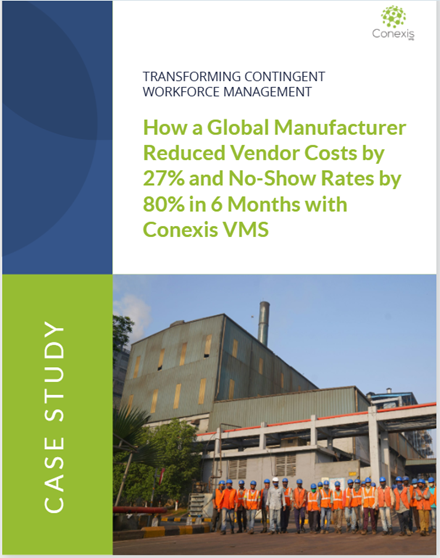
Case Study: How a Manufacturer Cut Costs by 27% and No Shows by 80% with Conexis VMS
The Conexis VMS Difference
Conexis VMS is an award-winning vendor management system built for organizations that want the power of enterprise software without the complexity or cost.
Leveraging the latest technology, Conexis VMS delivers the expertise, reliability and security of enterprise systems, while offering the flexibility, user friendliness and tailored, personal service you require. Learn more about our Company and what makes Conexis VMS different.
Discover the Power of Conexis VMS
Conexis VMS is trusted by staffing agencies, MSPs and leading organizations to modernize and manage their contingent workforce programs. Here's why organizations choose Conexis VMS:
-
Modern VMS Technology - Built on the latest AWS microservices architecture and Open API
-
Fast Implementation - Get up and running in under a month, free setup and training included
-
Fully Branded White-Label VMS - Your Logo. Your Domain. Your Branded Communication
-
Flexible Pricing - No setup fees, with free implementation, training and account management
- Personal Attention - Experienced senior account management from implementation onward
Switching Your VMS or Just Getting Started?
We work with teams at every stage, from first-time buyers to companies replacing outdated platforms that can't keep up. Either way, we'll show you what a modern VMS looks like, up and running in under 30 days.
 |
 |
 |


 Read More