Manufacturers often struggle to control contingent workforce costs because of limited spend visibility, inconsistent staffing vendor rates and decentralized workforce management across multiple plants. A Vendor Management System (VMS) centralizes workforce data, standardizes rate cards, controls markups, validates invoices and tracks vendor performance - helping manufacturers reduce unnecessary labor costs and improve procurement control across every location.
What Is Contingent Workforce Cost Control in Manufacturing?
Contingent workforce cost control in manufacturing is the ability to track, manage, and optimize spending on temporary labor, staffing vendors, and contractors across all locations. Without centralized systems, costs often become fragmented, inconsistent, and difficult to control.
Can You Answer These Right Now?
- What is your total contingent labor spend across all plants?
- Are you paying the same rates for the same roles in the same locations, across vendors?
- Which locations have the highest staffing rates - and why?
- Are you being overbilled or paying for duplicate workers?
- Which vendors deliver the best value for cost?
If these answers aren’t immediately clear, you don’t have cost control - you have cost exposure.
The Problem: Why Manufacturing Labor Costs Spiral Out of Control
Manufacturing organizations rely heavily on contingent labor to maintain production flexibility. But without the right systems in place, that flexibility comes at a cost.
❌ No Visibility Into Contingent Labor Spend
Spend is often spread across multiple plants, vendors, and systems - making it nearly impossible to track in real time. Hiring managers may focus on filling immediate production needs without having access to current market rates or organization-wide spending data. As a result, inflated rates can become embedded in plant-level budgets and remain undetected.
❌ Rate Inconsistency Across Vendors
Different vendors charge different rates for the same roles, with no standardization or benchmarking.
❌ Maverick Spend Across Plants
Individual locations engage vendors independently, leading to uncontrolled and inconsistent purchasing behavior.
❌ Duplicate Workers and Overbilling
Without centralized tracking and invoice automation, organizations risk paying for duplicate placements, inflated hours, or incorrect invoices.
❌ No Standardized Rate Cards
It's difficult to enforce contracted prices and markups, which results in costs being too high and missed savings opportunities.
The result: higher labor costs, lower efficiency, and limited procurement control.
The Real Questions Procurement Teams Are Asking
- “Why are we paying different rates for the same role?”
- “Where is our contingent labor budget actually going?”
- “Which vendors are driving up costs - and are they worth it?”
These aren’t just financial questions - they’re operational risks.
How a VMS Reduces Contingent Workforce Costs
A Modern Vendor Management System (VMS) gives procurement teams the tools to standardize, control, and optimize workforce spend across the entire organization.
Here’s how:
1. Full Visibility Into Workforce Spend
A VMS consolidates all contingent labor data into a single platform, providing:
- Real-time spend dashboards
- Cost breakdowns by plant, role, and vendor
- Historical trends and forecasting
- AI rate intelligence to help identify potentially excessive rates
You move from guessing costs to understanding and controlling them.
2. Standardized Rate Cards Across Vendors
With a VMS, you can define and enforce:
- Standard bill rates by role and location
- Pay rate ranges and markups
- Pre-approved pricing structures
This eliminates rate inconsistency and ensures fair, competitive pricing.
3. Elimination of Rogue Spend
A VMS centralizes vendor engagement, ensuring:
- All requisitions go through a structured process
- Only approved vendors are used
- Procurement policies are enforced across all sites
This brings discipline and governance to workforce spending.
4. Invoice Validation and Overbilling Protection
Automated invoicing and validation help:
- Eliminate duplicate billing
- Ensure invoices use contracted rates and markups
- Verify submitted hours
- Match invoices with approved time and assignments
You stop paying for errors - and start paying only for value delivered.
5. Better Control Over Time, Overtime and Shift Costs
Manufacturing labor costs are influenced by more than bill rates. Unapproved overtime, inaccurate time submissions, missed breaks and inconsistent shift premiums can all increase workforce spending.
A VMS can help manufacturers:
- Apply the correct rates for regular time, overtime and shift premiums
- Route overtime through defined approval processes
- Validate time before invoices are generated
- Identify unusual time or cost patterns
- Improve labor-cost visibility by shift, department and location
6. Vendor Performance vs Cost Analysis
A VMS allows you to evaluate vendors not just on cost - but on value:
- Cost per hire
- Fill rate vs price
- Worker quality and retention
This helps you identify the vendors delivering the strongest combination of cost, quality, reliability and service.
The Multi-Site Advantage: Controlling Costs Across Every Plant
For manufacturers operating multiple locations, cost control becomes exponentially more difficult without centralized oversight.
A VMS enables:
Cross-Site Cost Comparisons
Identify which plants and hiring managers are overspending and why.
Location-Based Rate Standardization
Embed contracted vendor pricing and markups across regions and facilities.
Enterprise-Level Spend Optimization
Make strategic decisions using organization-wide data rather than siloed reports. Manufacturers can also identify opportunities to consolidate spend among high-performing vendors and negotiate more competitive pricing based on total volume.
This transforms procurement from reactive purchasing to strategic cost management.
Business Impact: What Cost Control Actually Delivers
When manufacturers implement structured workforce cost controls, they can achieve measurable improvements in several areas:
Reduced Labor Costs
Eliminate inefficiencies, overbilling, and rate inconsistencies.
Improved Budget Accuracy
Track and forecast spend with confidence.
Faster Decision-Making
Access real-time cost data across all locations.
Stronger Vendor Negotiation Power
Use consolidated spend, vendor performance and pricing data to negotiate more competitive rates and terms.
How Conexis VMS Helps Manufacturers Reduce Costs
Conexis VMS is built to help manufacturing organizations gain full control over contingent workforce spend - without adding complexity.
Here’s how Conexis VMS supports your teams:
- Real-Time Spend Visibility Across All Sites: See exactly where your contingent workforce budget is going.
- Built-In Rate Card Controls: Apply approved pricing across vendors, roles and locations.
- Automated Invoice Management: Validate time, rates and markups before invoices are approved.
- Vendor Performance and Cost Analytics: Compare supplier cost, quality, responsiveness and results.
- Fast Implementation: Begin controlling costs in weeks - not months.
With Conexis VMS, cost control becomes proactive, not reactive.
Final Thoughts
Manufacturing organizations don’t overspend on contingent labor because they choose to - they overspend because they lack visibility, standardization, and control.
Without centralized controls, contingent workforce costs can increase gradually and remain difficult to detect.
With a modern VMS, you can:
- See exactly what you’re spending
- Standardize how you spend
- Optimize where you spend
Ready to Reduce your Contingent Workforce Costs?
You don’t need to wait months to gain control over your workforce spend. With Conexis VMS, you can be live in weeks - not months.

Frequently Asked Questions
1. Why are contingent labor costs so high in manufacturing?
Contingent labor costs are often high due to lack of visibility, inconsistent vendor rates, decentralized hiring across plants, and unmanaged supplier performance. Without a centralized system, manufacturers often overpay for the same roles and struggle to control spend.
2. How can manufacturers reduce contingent workforce costs?
Manufacturers can reduce costs by centralizing workforce management, standardizing vendor rates, tracking supplier performance, and gaining real-time visibility into labor spend. A Vendor Management System (VMS) enables all of these capabilities in one platform.
3. What causes inconsistent staffing vendor rates?
Inconsistent rates typically occur when multiple vendors operate independently across locations without standardized rate cards or procurement oversight. This leads to different pricing for the same roles and missed cost-saving opportunities.
4. What is maverick spend in contingent workforce management?
Maverick spend refers to hiring or purchasing outside of approved vendors, processes, or pricing agreements. In manufacturing, this often happens at the plant level and results in higher costs, reduced control, and lack of visibility.
5. How does a VMS help control contingent labor costs?
A VMS can reduce contingent workforce cost by centralizing workforce data, enforcing rate standardization, tracking vendor performance, and automating invoicing. This helps eliminate overbilling, reduce inefficiencies, and give procurement teams full control over workforce spend.
6. How quickly can a VMS reduce costs?
The timing and amount of cost savings depend on the organization’s current processes, rate inconsistencies, supplier arrangements and implementation scope. Some savings opportunities may be identified quickly through improved spend visibility, invoice validation and rate-card controls, while broader savings typically develop as the organization standardizes processes and uses performance data to improve vendor decisions.
Additional Reading
- How a VMS helps Manufacturers Improve Time-to-Fill
- How a VMS helps Manufacturers Reduce Compliance Risk
- How a VMS helps Manufacturers Increase Workforce Visibility
- How a VMS helps Manage Shift-Based Workers
Why Conexis VMS is the Right Choice for Manufacturing & Light Industrial
Conexis VMS is purpose-built for companies with complex, shift-based, multi-location operations. From worker classification and tenure tracking to rate standardization and supplier accountability, Conexis VMS gives manufacturing organizations the automation and control needed to manage risk and cost across every site, without adding administrative burden.
Built on a modern, configurable architecture, Conexis VMS adapts to the realities of manufacturing environments: multiple locations, blended workforces of contractors and self-sourced workers, and the compliance complexity that comes with scale.
Key Advantages:
- Ease of Configuration: Conexis VMS adapts to your existing workflows, shift models, and supplier network - without long or complex implementations.
- Real-Time Visibility: Every facility, every role, every worker - all visible in one dashboard.
- Automation Built for Scale: From requisition to invoicing, Conexis VMS removes manual steps, freeing your team to focus on strategic workforce planning.
- Secure, Compliant, and Auditable: Built-in compliance tools, automated credential tracking, and identity verification ensure every worker meets your standards.
- Advanced AI Driven Forecasting: AI-driven analytics help anticipate demand, ensuring the right number of qualified workers are available when and where you need them.
- Designed for Manufacturing, Warehouse and Logistics: Conexis VMS supports shift-based work, variable pay structures, and multi-site coordination - critical for fast-moving, high-volume environments.
Read more at Conexis VMS for Manufacturing and Conexis VMS for Warehouse & Logistics
Conexis VMS Case Study
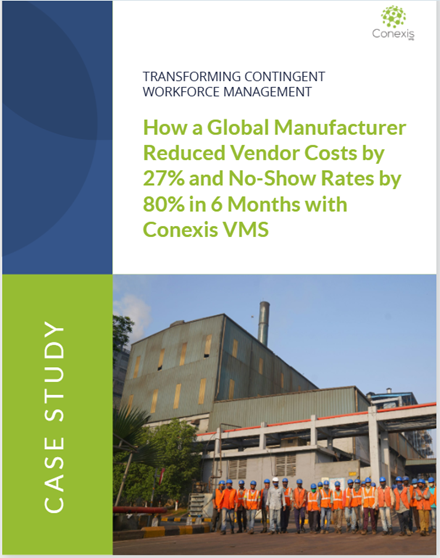
Discover how a Global Consumer Products Manufacturer Reduced Vendor Costs by 27% and No-Show Rates by 80% in 6 Months with Conexis VMS. Read our Case Study
The Conexis VMS Difference
Conexis VMS is an award-winning vendor management system built for organizations that want the power of enterprise software without the complexity or cost.
Leveraging the latest technology, Conexis VMS delivers the expertise, reliability and security of enterprise systems, while offering the flexibility, user friendliness and tailored, personal service you require. Learn more about our Company and what makes Conexis VMS different.
Discover the Power of Conexis VMS
Conexis VMS is trusted by staffing agencies, MSPs and leading organizations to modernize and manage their contingent workforce programs. Here's why organizations choose Conexis VMS:
-
Modern VMS Technology - Built on the latest AWS microservices architecture and Open API
-
Fast Implementation - Get up and running in under a month, free setup and training included
-
Fully Branded White-Label VMS - Your Logo. Your Domain. Your Branded Communication
-
Flexible Pricing - No setup fees, with free implementation, training and account management
- Personal Attention - Experienced senior account management from implementation onward
Switching Your VMS or Just Getting Started?
We work with teams at every stage, from first-time buyers to companies replacing outdated platforms that can't keep up. Either way, we'll show you what a modern VMS looks like, up and running in under 30 days.
 |
 |
 |



 Read More